
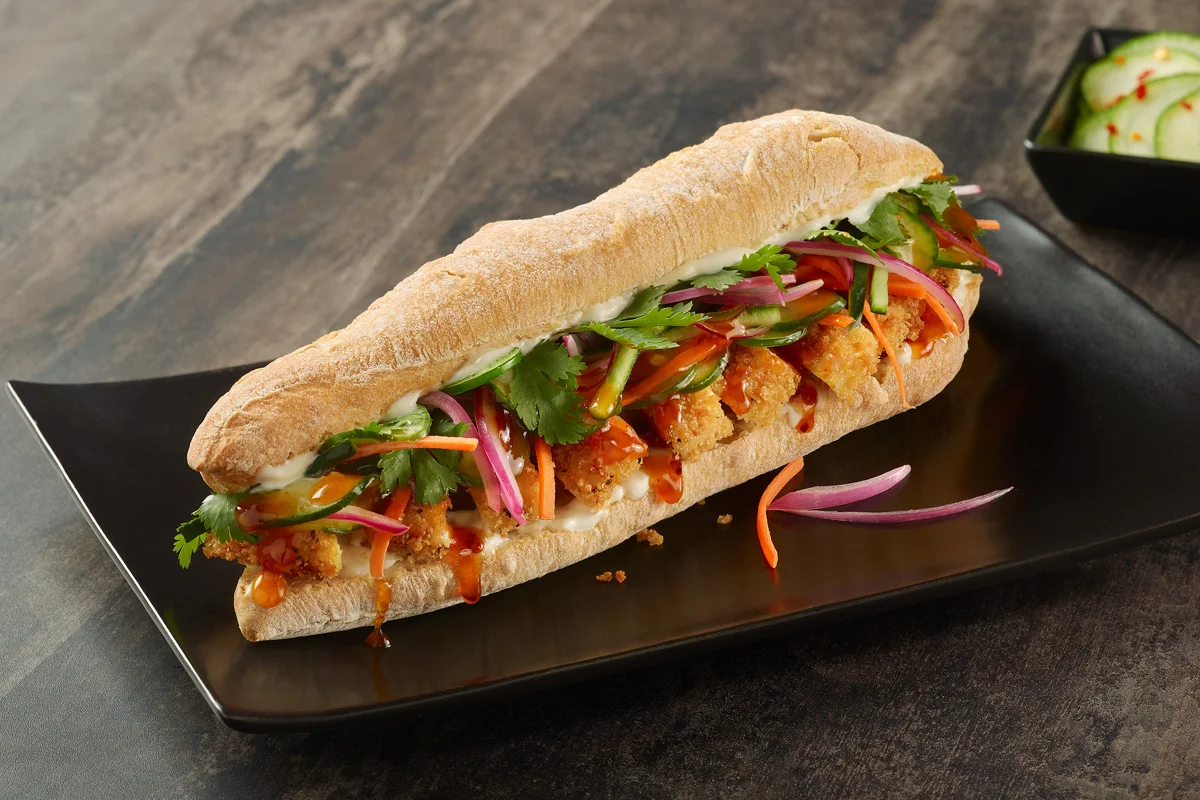
This Chili Crisp Hot Honey Katsu Banh Mi is a fresh take that represents the essence of third-culture cuisine.
Credit: otysonphoto.com
KC Flavor Champion: Justin Fong
Fusion concepts succeed when each flavor earns its place in the build
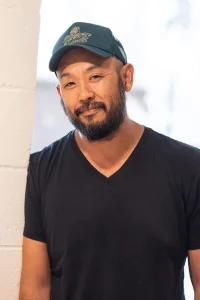
Justin Fong
“Hot honey changed my life.” Justin Fong concedes there might be a little exaggeration in this declaration, but his underlying admiration for the flavor pairing often comes into play in his recipe development projects as partner of Full Tilt Hospitality, which operates four restaurant concepts in California’s greater Sacramento area: Buckhorn BBQ + Grill, Buddha Bowls and Rolls, No Sabo Concheria and Drunken Tortilla. The sweet heat was also a key component in his Chili Crisp Hot Honey Katsu Banh Mi sandwich concept, which earned him the top prize from Kitchen Collaborative sponsor Lee Kum Kee. Developed by Flavor & The Menu and Summit F&B in 2020, Kitchen Collaborative challenges participating chefs to push the boundaries of flavor innovation.
According to Fong, hot honey is such a perfect pairing, it continually leaves him asking, “How come I didn’t think of this? It’s right in front of your face. It’s sweet and it’s hot, and a lot of Asian foods are like this, but you don’t think to put them together.” Actually, the first time he tasted hot honey was on pizza. “And I thought, ‘This is magical.’ And then I had it on cheesecake, and again, I thought it was magical.”
This led Fong to start playing with his own variations, starting with adding pepper to a regular honey-based marinade used regularly at Buddha Bowls and Rolls. From there, the ideas kept flowing as hot honey unlocked the sweet-spicy trend across the industry. “Talk about changing my life. I find myself thinking about sweet heat all the time when it comes to menu development. It’s become such a large canvas. Even at our Drunken Tortilla concept, we’re currently playing with a hot honey salsa macha.”
To make best use of Lee Kum Kee’s Chili Crisp Hot Honey in a Kitchen Collaborative menu concept, he borrowed from his Buddha Bowls and Rolls concept, which offers fresh interpretations of the classic Vietnamese banh mi, a sandwich he’s been eating for 30 years. While the local Sacramento restaurants of his youth still hold fast to traditional builds, Fong sought to inject greater diversity into this iconic favorite.
He fully embraces the concept of third-culture cuisine, self-identifying as “an Asian American who opened a Mexican restaurant in Beirut, Lebanon, of all places.” As he started to conceptualize the menu for Buddha Bowls and Rolls, he asked himself, “Why can’t we put Japanese-forward ingredients in a banh mi? Why can’t we play with more Chinese-style ingredients? Or change the baguette? Every culture has some version of a fried chicken, so why not throw that in a banh mi?” And that, he says, is what led to this dish for Kitchen Collaborative.
It’s nice to get out of the day-to-day wheelhouse of the brands I’ve built. Through Kitchen Collaborative, I see ingredients that are either newly coming on the market or are ones that I just don’t work with much. It’s good to exercise another part of the brain that doesn’t get as much of a workout, especially as the years go on!
—Justin Fong
The sandwich build features many traditional elements of a banh mi, such as pickled carrots and daikon, plus cilantro and jalapeños. Fong’s take drops the liver pâté in favor of crispy, Japanese-style chicken katsu, plus the Chili Crisp Hot Honey. While it still uses Vietnamese mayo, Fong’s is a signature version to which he adds a little fish salt to boost umami.
“But it’s the bread that really sets it off. I wish everyone in the competition could taste it!” Sourced from a local bakery, it’s a variation of a typical French baguette with a different sheer to the dough and a different chew after baking. “It is particularly good paired with the hot honey chili crisp,” adds Fong. “Just like how a good French baguette tastes with butter.”
“There’s a lot of texture going on in this sandwich,” he says. A bite produces several sensations, starting with the crispy, hot, outer edge of the bread. That’s followed by four really big flavor pops: acid from the pickled vegetables, sweetness from the honey, herbaceous notes from the cilantro and then some heat from chili crisp and jalapeños. And since the katsu chicken is breast meat without a lot of fat, the oil from the chili crisp and the mayo help coat the mouth. “There’s a style to the dish that’s traditional, but it’s also an amalgamation of things coming together,” he concludes.
WHY THIS PLATE PREVAILED
Fong holds that global mash-ups fail when little care is taken in how ingredients are combined. “Sometimes, you see recipes that really reach into left field, and this is what gives fusion a bad name. People throw ingredients together that really don’t make sense,” he notes.
At Lee Kum Kee, Susan Perry, senior channel marketing manager, shares this philosophy and credits Fong for avoiding such traps. The Chili Crisp Hot Honey Katsu Banh Mi “is a global mash-up that felt intentional, not forced,” she explains. “It was truly a fusion concept in every sense: Vietnamese banh mi and Japanese katsu brought together using our Chili Crisp Hot Honey Sauce, which itself is a Chinese-inspired fusion sauce.” The concept stood out as a reflection of current trends, particularly the momentum of Southeast Asian flavors.
Other factors that led Lee Kum Kee to declare the sandwich a winner included its overall creativity and “strong consumer resonance, balancing familiarity with an unexpected twist,” cites Perry. “Our sauce was not just an add-on. The chef used our product to create a more layered and dynamic flavor experience. We appreciate how it worked in harmony with the fish sauce mayo and the traditional Vietnamese sandwich components. It has flavor complexity, yet still is very approachable.”
LOOKING AHEAD
While the Kitchen Collaborative process didn’t necessarily introduce Fong to new products that weren’t already on his radar, he appreciates the message they carry about the future direction of menu development. “It’s a signal that suppliers, co-packers, developers of flavors and textures are sending to the broader market: They think these flavor trends are here to stay,” he says. “It’s confirmation to me that I’m climbing the right tree. And as I build out my brands, I know there are suppliers that are working to scale some of these ingredients, like chili crisp, that are going to be on the menu for a decade or more.”
Fong, who insists he hasn’t won anything “in a very long time,” is understandably tickled by the recognition—and the big prize: a culinary expedition led by Flavor & The Menu and Summit F&B to Mendoza, Argentina. Despite a solid decade traveling and working abroad, his sojourns never brought him to South America, so he’s understandably excited about the upcoming trip. Having a barbecue focus at his Buckhorn concept, he is especially looking forward to learning more about Argentina’s famed live-fire cooking. Plus, he’s interested in comparing Mendoza wine country against his youthful memories of family trips through the Napa Valley.
With some “kitchen Spanish and Mexican slang” under his belt, and the help of Google Translate, Fong is confident he can get around comfortably. But he is genuinely eager to immerse himself and learn from locals. “I find it really empowering to be in a country where you don’t speak the language, because that’s where you learn human kindness and empathy more than anything.”
MORE INSPIRED TAKES
As with many of his peers, Fong finds himself drawn to the entire global pantry of flavors and ingredients, seeking to pair those that “make sense” together. Here are two more examples that serve up unconventional success.
Smoked Zacatecan Chorizo and Tuscan Tomato Pasta Salad
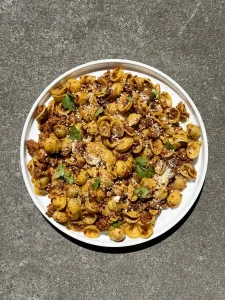 Presented with Al Bronzo Orecchiette from sponsor Barilla for Professionals, Fong was briefly stumped. “Initially, I didn’t know what to do with it. Pasta isn’t my strong suit; I don’t eat a lot of it.” But a well-timed inquiry from a coworker about adding a pasta salad to the menu at Buckhorn sparked an idea.
Regularly disappointed by spiral pastas that don’t capture other ingredients, Fong was inspired by the “magical orecchiette shape, which soaks up flavors, maintains its texture when chilled and holds other ingredients really well.”
Those other ingredients include a smoked, Zacatecas-style ground chorizo (for spice), aged Cotija (for umami) and a little bit of cilantro (for color and freshness). Binding these was the Tuscan Tomato paste from sponsor SupHerb Farms. “The paste is tangy but a bit sweet-forward, and still savory. So, I thought the spicy, smoked chorizo would make a good pair,” he reflects. So good, in fact, that he wound up making three pans of the dish and sharing it with his coworkers. “They’re used to me making all kinds of crazy stuff. But they tried this and went, ‘wow.’”
The dish might show up on the Buckhorn menu one day. “This is something that is far superior to the traditional macaroni salad,” says Fong. “So, we’re thinking about how it might scale and how it might be received by our customers. It is a little out there. But as the flavors become more acceptable to the general palate, it might make it.”
Chili Crisp and Doenjang Blue Cheese Fries
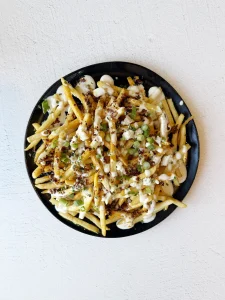 Doenjang. Blue cheese. It may not be the first ingredient combination that comes to mind when devising a distinctive topping for loaded fries, but it’s certainly a singular addition to the spectrum of options showing up in menu mentions. “Doenjang and blue cheese just work. I honestly don’t know why,” admits Fong. “Maybe it’s that each ingredient, on its own, packs an unusual amount of umami through fermentation and aging. You combine it with a slightly smoky, hot and sweet chili crisp, five-spice and thin, crispy fries, and it’s magic. As simple as it may seem, there is a lot going on in this dish.”
The concept is an homage to a memorable variation—with blue cheese dressing, hot Italian oil and parsley—from a local Sacramento eatery that was a go-to for Fong in his 20s, “long before loaded fries were a thing.”
But he wanted to do more than play with nostalgic memories. “I wanted to make an Asian version,” he explains, noting that he’s also exploring a similar build at Buddha Bowls.
For Kitchen Collaborative, Fong employed Blue Cheese and Chili Crisp Hot Honey Sauce from sponsors BelGioioso and Lee Kum Kee, respectively. The doenjang, which he thinks of as the Korean version of miso, adds depth of flavor. “It’s been a big part of my life, and you start to develop an understanding in the back of your head about what’s going to work well. It actually didn’t seem too far of a stretch. They just make sense together.”
Another key ingredient was Chinese five-spice, a seasoning Fong “puts on everything.” He uses it to coat the potatoes right after they emerge from the fryer. Then, chili crisp is spooned on and the cheese and doenjang are mixed together and applied with a squeeze bottle. Sliced green onions are a finishing touch.
Look for more profiles of this year’s Kitchen Collaborative winners in the weeks ahead.
Kitchen Collaborative Project Management: Summit F&B
Chili Crisp Hot Honey Katsu Banh Mi photo: Photography: otysonphoto.com // Food Styling: Peg Blackley
About the Author
 Patricia Fitzgerald serves different roles on the Flavor & The Menu team, including writing custom content, Kitchen Collaborative chef spotlights and digital editorial content, as well as acting as a contributing editor for the print magazine. As owner of PFitzCommunications, she specializes in various areas of foodservice and hospitality, while also maintaining clients in other industries and professions. She can be reached at [email protected].Click to Read More Stories by Patricia Fitzgerald
Flavor Trailblazer: Justin Mosel Keeping a heritage brand relevant through disciplined innovation, sharper value and a willingness to take risks
Flavor Trends, Strategies and Solutions for Menu Development[google_sidebar_ad...
Snack Attack How snacks and small bites are packing a big flavor punch
Flavor Trends, Strategies and Solutions for Menu Development[google_sidebar_ad adslug="2026-09-Surround-Lactalis-320x50"...
Refreshers on the Rise Operators lean into fruit, sparkle and energy to deliver modern beverage appeal
Flavor Trends, Strategies and Solutions for Menu Development[google_sidebar_ad adslug="2026-09-Surround-Vibrant-320x50"...
