


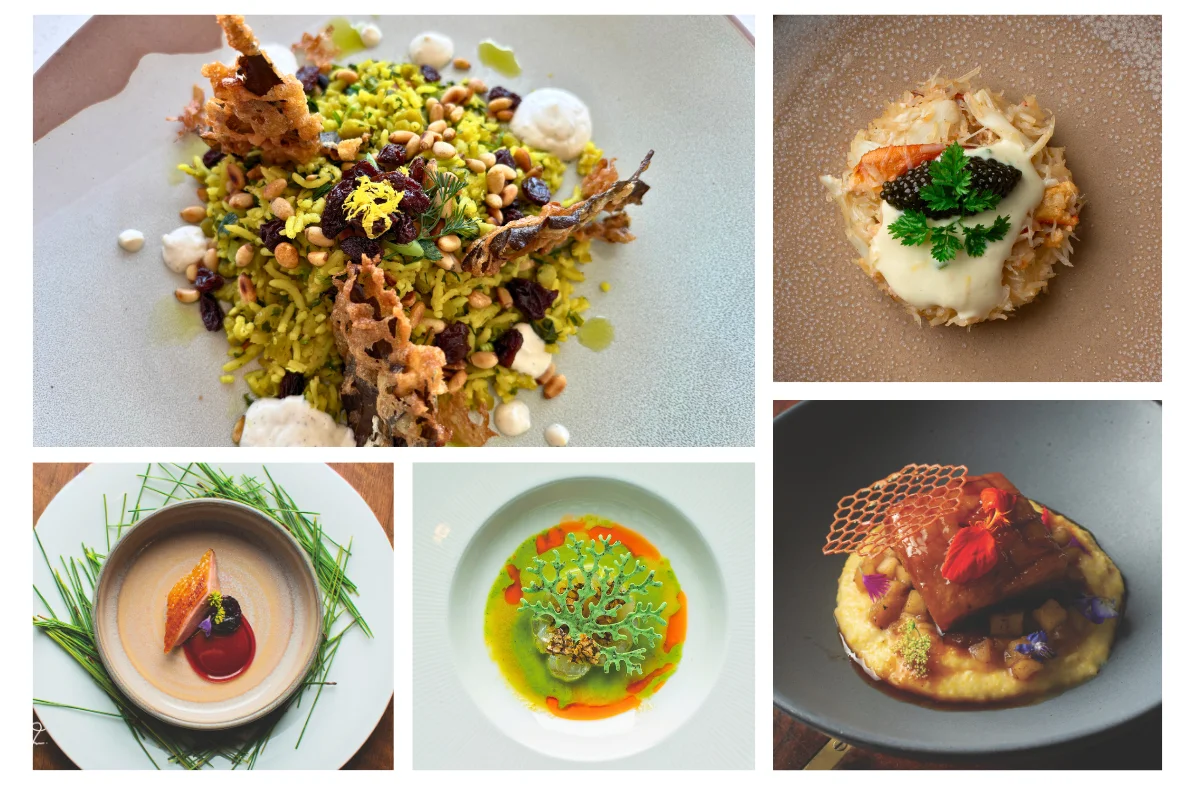
Clockwise from top left: Barg-e-Mo Salad, Crab With Naan, Bee-Ham, Kombu Lime Bass Crudo and Duck in the Pines
Credit: Johnson & Wales University
PARTNER EDITORIAL
A Culinary Sense of Place
Five standout dishes from Johnson & Wales students
Persian Roots, Modern Interpretation
Traditional Persian barg-e-mo (stuffed grape leaves) provided the seed of inspiration for rising junior Behnaz Zobeiri when building a salad of the same name. The Barg-e-Mo Salad deconstructs the handheld mezze, transforming it into a plated marvel: A base of rice, yellow split peas and pine nuts is dramatically garnished with crispy grape leaf tempura. Fresh herbs like oregano and dill, as well as cinnamon and raisins, distinguish the Persian iteration from the more common Greek dolma. “While keeping the traditional Persian flavors, fresh herbs and warm spices, I worked to present it in a more modern way but still make it taste like home,” Zobeiri says. The salad is finished with a tahini-yogurt sauce that walks the line between dip and dressing.
Zobeiri, who immigrated from Iran two years ago to pursue her culinary dreams, credits her grandmother with cultivating her interest in cooking. “One of my favorite memories with her was staying up all night together making hundreds of dolmas by hand,” she recalls. “This dish reflects my heritage, childhood memories and personal culinary journey.”
Cross-Cultural Crustacean
Crab With Naan, from JWU alum Loryne Burrows (class of 2025), celebrates Indian flavors but with a nod to French techniques. Fresh Jonah crab is poached in butter that’s been infused with garlic, shallot, tarragon and black sesame. The crab is then combined with a curried crab bisque tableside and topped with lemon and chive crème fraîche. The dish was created for the launch of a student capstone pop-up concept, Sahba, which sought to elevate the aromatic spices of Indian cuisine through a classical cooking lens. Sahba translates to “shared food,” reflecting the importance of eating together in Indian culture.
Forests of Flavor
A native New Yorker, rising senior Daron Sklar found an unlikely culinary narrative in the trees of Rhode Island, pine in particular. Ducks are often raised with pine wood shavings as bedding, just as lapsang souchong (a black tea from Fujian, China) is roasted and preserved with pine smoke. This connection is made manifest in the Duck in the Pines entrée, featuring salt-cured, dry-aged duck, lapsang white balsamic compressed cherries, lapsang white balsamic glass noodles and pine needle jus. Once plated, the dish is nestled atop fresh pine needles for a visual and aromatic flourish.
Cured by the Coast
Wishing to bring a bit of the tropics with him to culinary school, new JWU graduate Aaron Martinez de Los Santos created the Kombu Lime Bass Crudo. “Growing up in the Dominican Republic, seafood was always a part of life: bright, simple and full of energy,” he says. “When I came to Rhode Island, that same sense of freshness and connection to the water felt familiar.” Los Santos sourced local black bass and prepared it using kombujime, a Japanese technique in which raw seafood is wrapped in sheets of kombu and cured overnight. This method brings out the natural umami of the fish without overpowering it. The cured bass is served in a yuzu-cilantro broth with tamari, salsa macha, leche de tigre and thematically on-point lime zest tuile shaped like seaweed. The overall result is as fresh and vibrant as the coast itself.
Sweet Home Alabama
Newly minted JWU graduate Nate Siple points to sustainability coursework and his kitchen jobs back home in Birmingham, Ala., as the driving forces behind the Bee-Ham, a barbecue honey-glazed pork belly. Creamy goat cheese polenta is dotted with finely cubed spiced apples and edible flowers, serving as the base for the luscious square of barbecue honeyglazed pork belly. A dainty and perfectly molded honeycomb tuile crowns the dish. “The ‘bee’ is represented by the barbecue honey glaze, honeycomb tuile and flowers. And ‘ham’ is, of course, represented by the pork belly,” Siple says. Thanks to a class on sustainable food systems, he discovered “a new obsession for not only cooking great food, but sourcing sustainably, too.” Now, Siple is pursuing both passions in Connecticut, working in the kitchen of Chef Reneé Touponce and part-time at the Yellow Farmhouse Education Center.
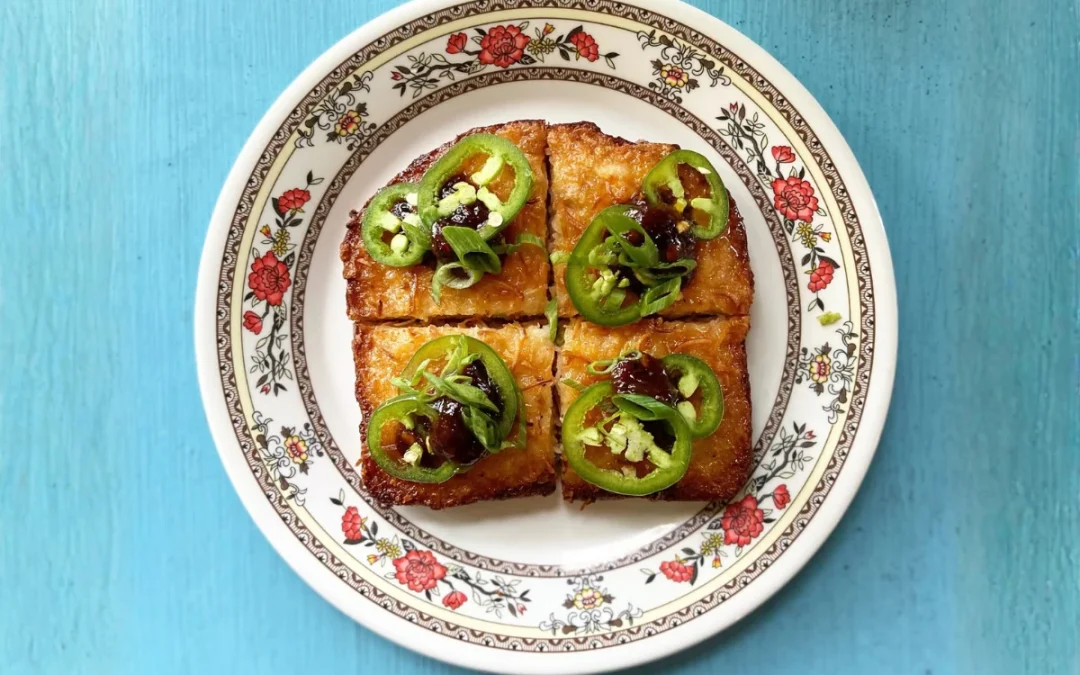
Bites & Sips: Fresh Chinese Mash-Ups and New Matcha Moves Exploring micro-trends, one bite and sip at a time
Flavor Trends, Strategies and Solutions for Menu DevelopmentNo longer restricted to dim sum, shrimp...
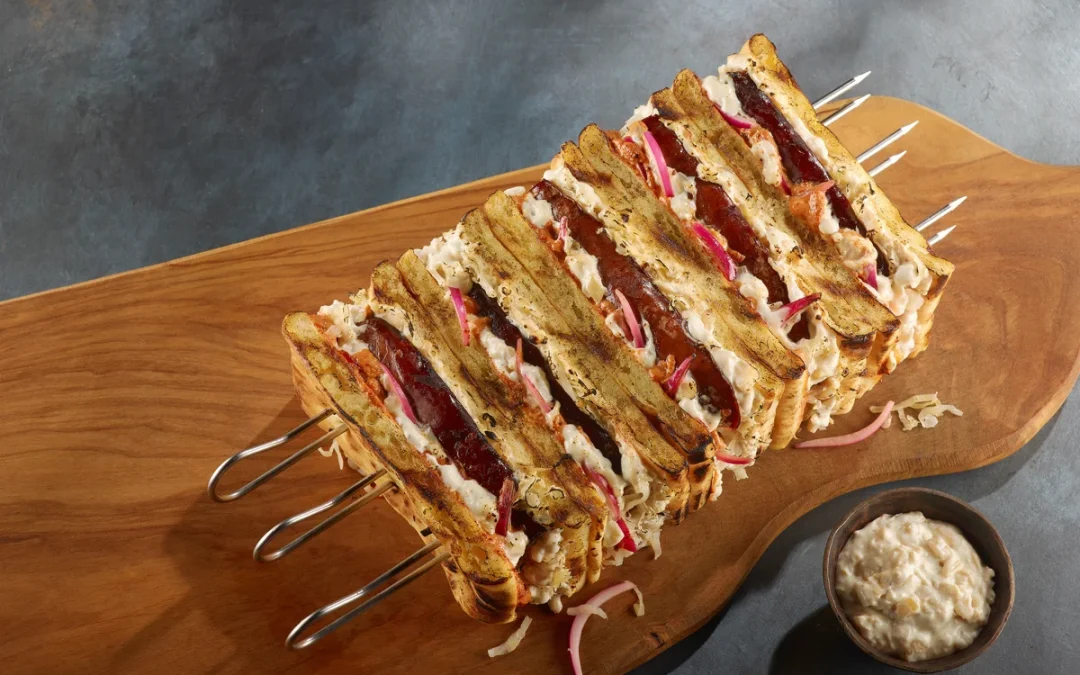
KC Flavor Champion: Joseph Antosiak Swinging for the culinary fences yields award-winning results
Flavor Trends, Strategies and Solutions for Menu DevelopmentThis Grilled...

Flavors on the Edge: Buldak Sauce Fueled by viral ramen, Korea’s fiery, savory-sweet buldak flavor is breaking out of the noodle packet and onto restaurant menus
Flavor Trends, Strategies and Solutions for Menu Development[google_sidebar_ad...
